
Local Lead Generation: How to Do It Right in 2026
Local lead generation is the process of attracting prospective customers in your area. Once you have their attention, you spark their genuine interest in your company’s offerings and get them to take action.
Not long ago, finding local prospects equaled placing newspaper ads and handing out flyers. Now the tools have gone digital. I’ve gathered ones that work best: an optimized Google Business Profile, personalized email outreach, hyperlocal content, and seven other strategies you can’t miss in 2026.
But before we look at the strategies, I’ll explain what local lead generation is and whether it’s right for you. You’ll also discover how to generate leads for your business in five simple steps.
Find verified email contacts for businesses nearby
Find Local LeadsWhat is Local Lead Generation?
Local lead generation is a marketing or sales strategy used to attract potential customers within a specific geographical area. The target zone can be as large as a regional chain of dental clinics in Southern California or as concentrated as a few blocks neighboring your business.
If you work within a defined territory, depend on foot traffic, and meet face-to-face, target nearby customers. This strategy is perfect for:
- Home service providers, such as plumbers, electricians, HVAC technicians, landscapers, and cleaning companies
- Professional service providers, including lawyers, accountants, financial advisors, and real estate agents
- Healthcare providers, including physicians, dentists, therapists, chiropractors, and local clinics
- Retail and hospitality businesses, such as salons, gyms, shops, restaurants, cafes, and hotels
- B2B companies, including commercial cleaning firms, office equipment suppliers, and others
When you attract prospects close by, you’re no longer competing with the whole world, just with businesses down the street. This tight focus reduces your customer acquisition cost (CAC) and ad spend and also increases conversion rates.
If you aren’t bound to a specific geographical area, you’ll likely get better results from more general marketing strategies.
The same applies to those who rely on third-party aggregator platforms. A good example is a hotel that gets 100% of its bookings from Booking.com. Or, let’s say, a business that fully operates on Amazon, Etsy, Upwork, or Fiverr, where the marketplace handles the local traffic itself.
Browse thousands of local business contacts by industry
Explore the DatabaseLocal Lead Generation Strategies for 2026
Local lead generation follows the same principles as any other lead generation strategy. The difference is that you target people in distinct territorial boundaries.
Here are ten local business lead generation strategies that prove effective in 2026:
Optimize Your Google Business Profile
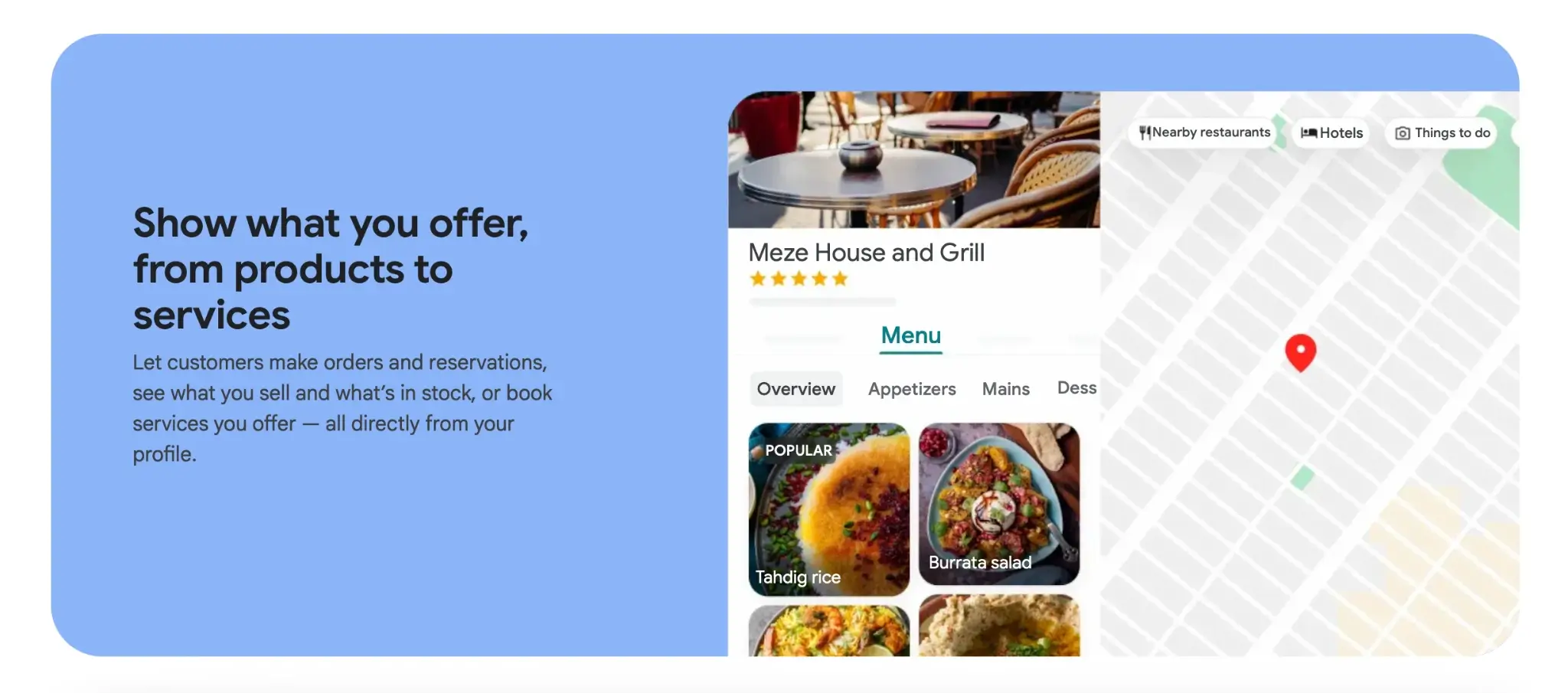
Your Google Business Profile remains the most accessible way to draw local prospects through Google Search and Maps. If you haven’t created your profile yet, make that a priority.
Setting up your profile is entirely free. Fill out basic details such as your business name and category. After that, customize the page by adding your working hours, address, services, images, and pricing info.
Once your profile is live, customers can leave reviews.
To increase your chances of ranking higher in local search results, you should continuously optimize your Business Profile. Here are a few tips:
- Use relevant local keywords in business and services descriptions
- Complete every field available in your profile
- Respond quickly to every customer review, positive or negative
- Publish updates and fresh pics on a weekly or bi-weekly basis
Visuals move the needle here. According to Google employee Lisa Landsman, 90% of people are more likely to visit a business that features photos on its Google Profile.
Consistency matters as much. GMB Daddy reports that companies that regularly upload new images tend to achieve better visibility in the Google 3-Pack (the top three location-based map results).
Use Personalized Email Outreach
Instead of waiting for prospects to find you, take the initiative with cold email outreach. However, inboxes are full of generic messages these days. To actually get replies, personalize your outreach.
First, figure out what challenges your target audience. Then, show them exactly how you can help. A converting email typically includes:
- A short subject line explaining the relevance or interest
- A personalized greeting using the recipient’s name
- A concise context statement linking to a shared local connection, pain point, or need
- A clear value proposition supported by social proof if possible
- A simple call to action
When your message is ready, you need to find accurate contact information. Tools like Skrapp make this process much easier. Just enter a company name or domain in the email finder to discover verified business email addresses.
If you already have a list of companies, you can use it to find local leads' email addresses in bulk. You can also build a lead list from scratch with AI search, advanced filters, or data pulled from LinkedIn profiles and search results.
The video below walks you through the process of finding email addresses in bulk for local outreach.
Create Hyperlocal Content
Leave general-purpose content for wider audiences. For local lead generation, be precise. Adapt your content to specific cities, neighborhoods, landmarks, or ZIP codes. You can publish the following:
- Neighborhood guides, for example, “Best Coffee Shops in Brooklyn” or “Apartment Rental Prices in Downtown Austin”
- Event coverage, including local festivals, markets, or community projects
- Local case studies featuring client success stories, nearby business partnerships, or community projects you support
- Area-specific service pages detailing your offerings in a target location
To keep visitors on your page longer, include interactive components where they make sense. Consider adding cost calculators, quizzes, interactive maps, and comparison tables.
Invest in Generative Engine Optimization (GEO)
Traditional SEO is great for local rankings, but search behavior is changing. People are googling less; instead, they ask AI for direct answers. According to McKinsey, 44% of users now prefer AI-powered search when looking for information.
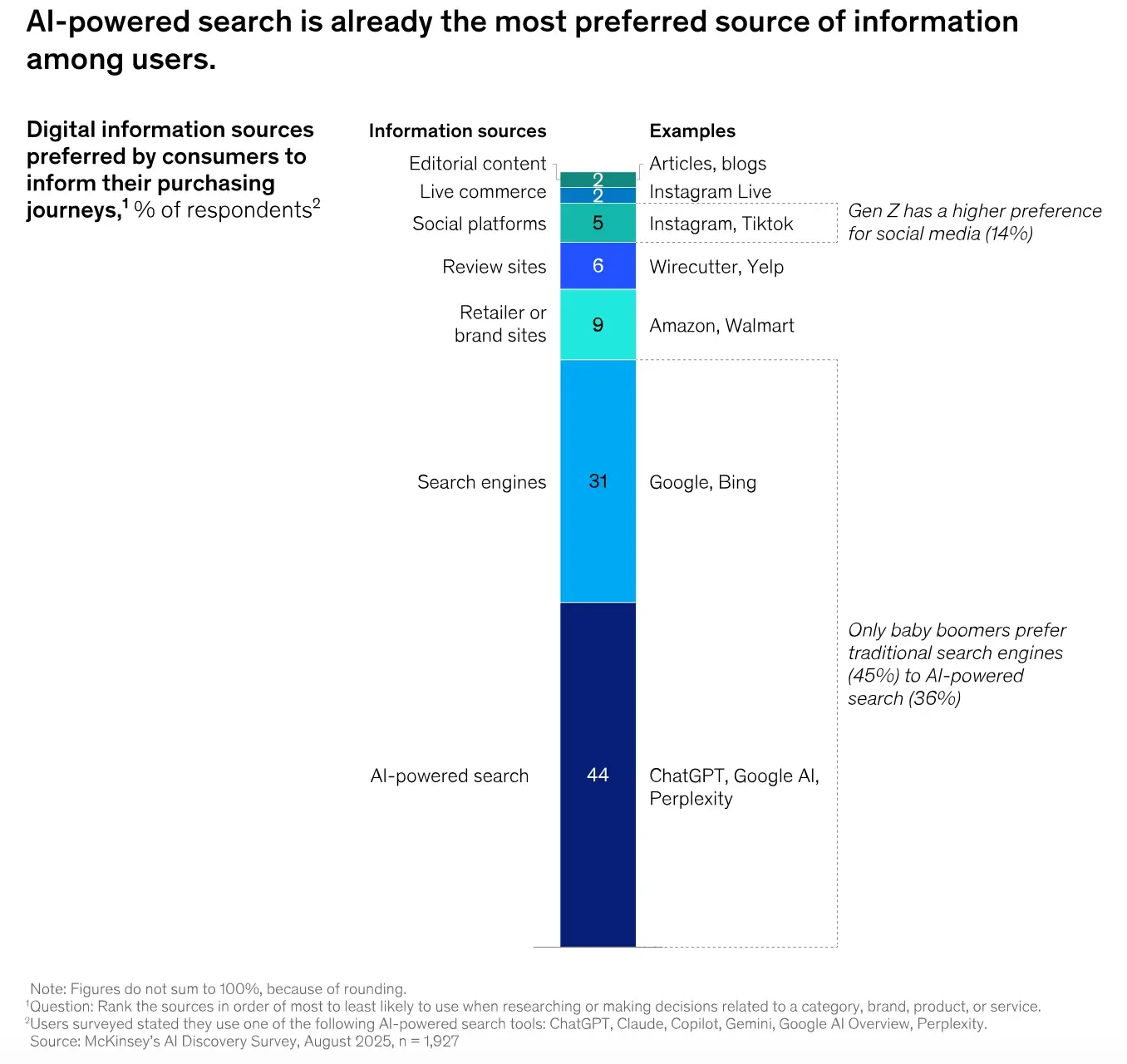
As AI search popularity grows, generative engine optimization (GEO) becomes essential. It makes sure your content appears in AI-generated responses from ChatGPT, Gemini, Claude, or Perplexity.
To improve visibility, create authoritative, structured, and natural content. Here’s how you can do that:
- Answer the main question in the first sentence or two, then add supporting details
- Use a logical heading structure containing clear H1, H2, and H3 tags
- Build credibility with direct citations and links to high-authority websites
- Wrap your content around natural questions your local customers typically ask
If you’re still wondering if GEO is worth the effort, look at Google’s latest research. Their AI Overviews alone now serve over 1.5 billion users across 200 countries and territories.
Build Local Partnerships
Networking is yet another effective method of lead generation for local businesses. Partner with non-competing, complementary firms, community organizations, and industry associations. Here is how to make these partnerships pay off:
- Launch mutual referral programs, where you promote each other’s businesses
- Co-host events, workshops, and webinars
- Offer discounts for employees or customers of neighboring businesses
This strategy works because your partners have already built trust with the audience you aim to reach.
Connect with nearby businesses for cross-promotion
Find Local PartnersGenerate Leads Through Google Maps Prospecting
Google Maps is one of the largest directories of brick-and-mortar businesses currently in existence. Use it for B2B lead generation in your target area. The process is as follows:
- Filter businesses by location, industry, services, ratings, and other parameters
- Create an initial list of prospects
- Run those names through a data enrichment tool
- Use discovered contact information to create personalized outreach campaigns
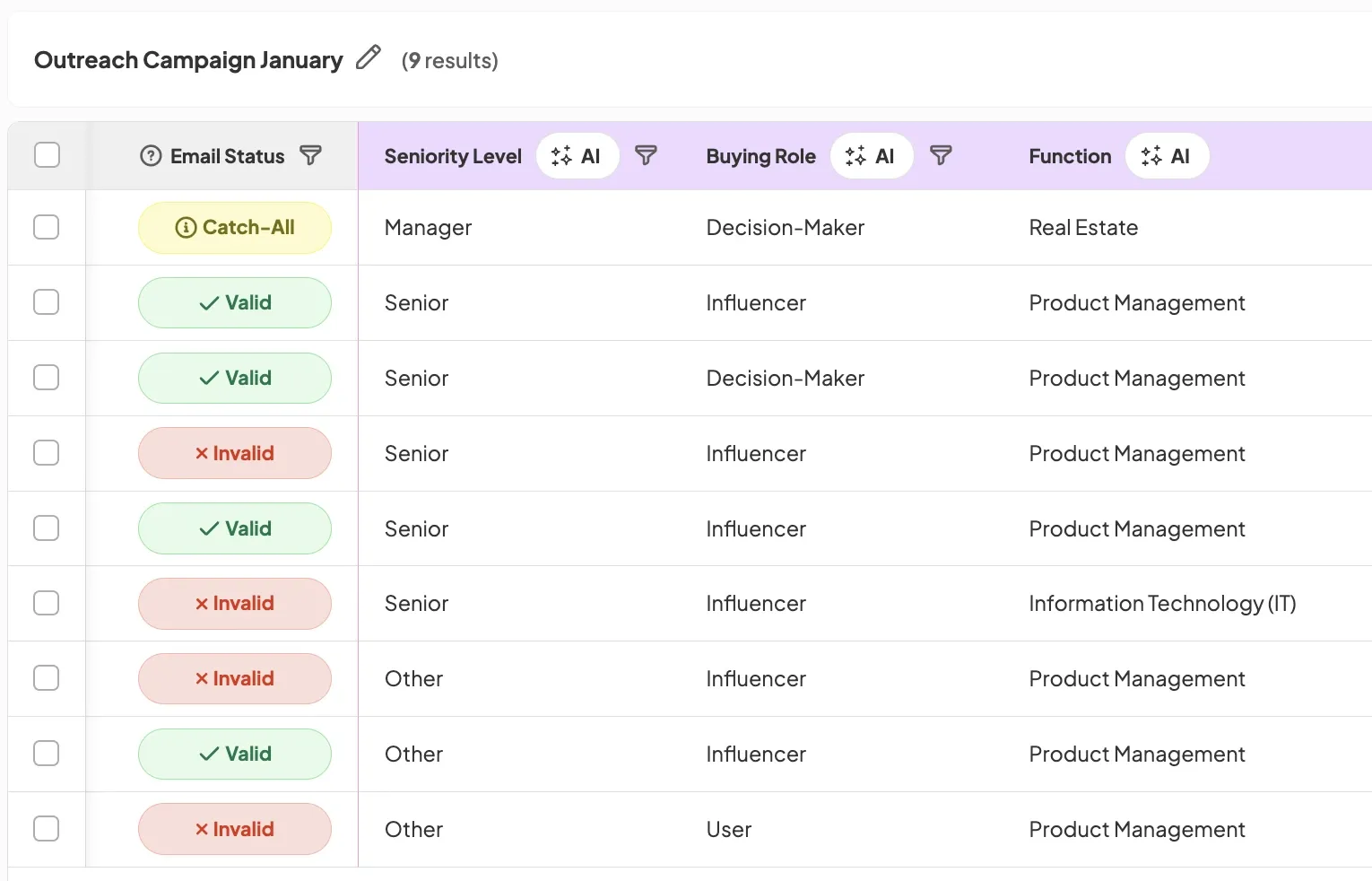
You can use Skrapp for the data enrichment step and AI-powered lead generation. It fills in the gaps with verified email addresses, job titles, company sizes, and other details generated through AI-powered enrichment fields.
Run Hyperlocal Paid Advertising
If you need immediate visibility, launch hyperlocal paid ads. These connect you with people actively looking for businesses in your service domain.
Your main paid channels include:
- Google Ads: A pay-per-click (PPC) model that targets specific keywords, appears in the middle or bottom of search results, and can also appear in Google Maps.
- Google’s Local Services Ads: A pay-per-lead model that adds a Google-verified badge and sits above all search results.
- Social media: Facebook, Instagram, TikTok, LinkedIn, and other social media channels for capturing nearby interest.
Most advertising platforms let you set your own budget. So you don’t need to invest a lot of money upfront. Start with a modest amount of around $300, and scale your investments once you see qualified local business leads.
Encourage Reviews and Referrals
Happy customers are your best “lead generators.” When they love your work, they are typically more than willing to leave a review or introduce you to their network.
In addition to social proof, reviews improve your local search rankings. For example, Google uses your business’s prominence (how well-known and trusted you are) to decide whether you get featured in the Map Pack.
Here’s how to get more reviews and referrals:
- Send a follow-up message inquiring about feedback right after a successful purchase or service
- Encourage your staff to prompt customers for a review in person
- Use QR codes that take customers to your review page in your brick-and-mortar location
- Provide discounts and other incentives to customers who bring new clients with them
Never ignore negative feedback. Respond within 24 hours, admit the issue, apologize, and explain how you’ll make it right. Potential customers judge your business just as much by how you handle complaints as they do by your high ratings.
Leverage Local Directories and Citation Sites
Be easy to discover by new prospects. Make sure your business is listed in the major directories and citation sites before expanding to local and industry-specific platforms.
For starters, create listings on Google Business Profile, Apple Maps, Bing Places, Yelp, Nextdoor, and Facebook. Then branch to more niche, regional directories. Attorneys can, for example, list on Avvo or Justia, medical professionals on Healthgrades, and home service businesses on Houzz.
You can also improve discoverability and credibility with the following efforts:
- Keep your NAP (Name, Address, Phone Number) consistent on every directory
- Use automated citation tracking tools like BrightLocal to audit your listings
- Earn unstructured citations, such as mentions in local blogs, news websites, or social media
Engage With Your Local Community
Finally, build relationships with your local community online and offline. Your goal is to become the one people talk about. Look for opportunities to:
- Attend or host local networking events and business meetups
- Sponsor community events or charity initiatives
- Participate in local Facebook groups and other community forums
The more involved you are in the community matters, the more likely people are to remember you. And whenever they need your services, they’ll get in touch with you or recommend you to others.
Effective local lead generation typically comes from combining several of the above strategies at once. Pick what looks suitable for your business, experiment, measure results, and improve over time. In the end, consistently do the right things for your specific market.
How to Generate Leads for Local Business in 5 Steps
So, how to do local lead generation? We’ve broken down the process into five simple stages. It all begins with a baseline audit, complete with a scalable strategy you can easily track.
Step 1: Check Where You Stand Right Now
Before you start generating leads, you should figure out how visible your business currently is. Run through the following checks:
- Google your business name and city. Does your Google Business Profile pop up with photos, reviews, and correct hours? Or is it half-empty?
- Search for what you do without your business name (for example, “plumber in [your city]”) in an incognito window. Do you make it to the Google Map Pack?
- Ask ChatGPT or Gemini something like “best [your service] in [your city]”. Does your business appear in the response?
- Google your business name and “reviews.” How many reviews are there? Is your average rating above 4.0?
Visibility checklist to go through:
- Google Business Profile complete? → Yes/No
- Appear in the Map Pack? → Yes/No
- Mentioned by AI? → Yes/No
- Review rating above 4.0? → Yes/No
Now that you know where you stand, go through the local lead generation strategies described above. Choose the ones you’re going to implement.
Basically, local lead generation tactics fall into two categories:
- Inbound strategies that attract local customers who are actively searching and ready to buy or order a service right now
- Outbound strategies that let you reach out to high-value prospects before they even start looking for your services
Here’s how you can categorize the ten strategies:
| Inbound Strategies | Outbound Strategies |
|---|---|
| Google Business Profile optimization | Personalized email outreach |
| Hyperlocal content | Local partnerships (co-promotion and outreach) |
| Local partnerships (referrals) | Google Maps prospecting |
| Generative engine optimization | Community engagement |
| Hyperlocal paid advertising | |
| Reviews and referrals | |
| Local directories and citation sites |
Step 3: Make a List of People or Businesses to Contact
Once you’ve decided on your core strategies, research local businesses to build your ideal customer profile (ICP).
Think about the type of business or customer you want to reach. Describe their location, buying behavior, pain points, and so on. This would be your ICP.
With this information in place, start sourcing local prospects using various channels:
- Google Maps: Search for specific business categories in your target area. After that, collect company details manually or with scraping tools.
- Local events: Find upcoming events your ideal customers are likely to attend. Then, pull the list of attendees or sponsors.
- Skrapp B2B Lead Finder: Use Skrapp’s B2B Lead Finder to research over 200 million verified contacts, filtering by location, industry, company type, revenue, and so on.
- Local SEO: Capture organic leads by ranking in the top 3 of Google’s Local Map Pack through GBP optimization, hyperlocal content, and directory citations.
- Lead magnets: Offer your customers something valuable in exchange for their contact details. Local guides, cost calculators, coupons, and checklists are great options.
- Direct contact enrichment: Use Skrapp or other local lead generation tools to pull verified email addresses for owners or general managers.
Get decision-maker emails for any business in your area
Start Finding EmailsStep 4: Launch an Outreach Campaign
Right now, you should have a detailed list of prospects. Use this information to start a conversation with your audience.
Lead with personal relevance: explain specifically why you are contacting them. Then follow with a concise value proposition.
Plus, choose communication channels your prospects typically use, whether:
- Direct mail
- LinkedIn messages
- Phone calls
- Social media DMs
And remember to follow up. Plan a sequence of about 3 to 4 messages over a two- to three-week window.
Step 5: Measure and Scale
Continuously track your core metrics to determine which of your lead generation efforts are most effective — and which need changes.
| Metric | Why it matters |
|---|---|
| Cost per lead | Shows which channels are the most cost-effective |
| Conversion rate | Measures which prospects eventually turn into customers |
| Lead response time | Tracks how fast your teams reply to leads; optimal window is under 5 minutes |
| Meetings booked | Evaluates your outreach campaign quality |
| Local search traffic | Shows your local search visibility |
Best Tools for Local Lead Generation
While we’ve touched on a few of these already, here is a summary of the main local lead generation software tools you can confidently use:
- Skrapp — Helps you find verified emails for local business owners and lets you filter prospects by region, industry, company size, revenue, and other criteria
- BrightLocal — Audits your GBP, monitors directories, and checks whether you rank in the Local Map Pack
- Podium — Automates review requests and lets you manage replies across Google, Yelp, and Facebook
- Google Sheets (or a simple CRM) — Allows you to track outreach list, replies, and monthly numbers
Of course, software won’t do all the networking and outreach for you. But it will simplify the process for sure.
Where Should Your Business Start?
Don’t try to launch all ten strategies at once. But exploring them would be a great start.
Once you do that, audit your online presence and target audience. From there, pick several approaches that match your findings. For the best results, combine inbound and outbound methods to reach local leads from multiple angles.
Build a targeted list of local prospects in minutes
Search the DatabaseFAQs: Local Lead Generation
What is local lead generation?
Local lead generation targets customers in a specific area, like your city or a set radius around your business, rather than trying to reach everyone everywhere. Plumbers, dentists, salons, and similar businesses rely on this because their customers are already nearby.
How do you generate local leads for a small business?
Check your current standing first: Google Business Profile, Map Pack ranking, reviews. Then fix up your GBP listing, write some content around local topics, ask happy customers for reviews, and reach out directly through email or local partnerships when you need faster results.
How can you use Yelp for local lead generation?
Claim your Yelp profile and fill out every section: hours, photos, categories. People forget Yelp listings show up in Google search and AI answers too, not just on Yelp itself. Answer reviews and messages fast.
What is local SEO for lead generation?
This means tuning your Google Business Profile, location pages, and citations so nearby customers find you first. Use location-based keywords, keep your business name, address, and phone number identical across every listing, and write content that actually mentions your area instead of sounding generic.
What is the Google Map Pack?
The Map Pack is that group of three business listings with a map that pops up at the top of Google when you search for something like "electrician near me." Most people click one of those three without scrolling further, which makes ranking there one of the biggest wins available for local businesses.
What's the difference between local lead generation and general lead generation?
With local lead gen, you're only competing with nearby businesses, so costs stay lower, and conversions tend to be better. General lead generation targets a wider audience and works for businesses that aren't tied to a physical location, like SaaS or online stores.
Is local lead generation still profitable in 2026?
It is, arguably, more than before. AI search tools like Google AI Overviews and ChatGPT now recommend local businesses directly in their answers. A well-run Google Business Profile with solid reviews still beats many paid campaigns on cost per lead.
How do you find local leads without paid ads?
Build out your Google Business Profile, publish content about your neighborhood or city, gather reviews on Google and Yelp, and partner with businesses nearby for referrals. Takes time instead of money, but it compounds.
What tools are used for local lead generation?
BrightLocal is local lead generation software that works well for auditing your GBP and citations. Skrapp helps find contact info when you're doing outreach. For tracking leads, a simple Google Sheet or CRM does the job just fine.
How does Google Business Profile help with local lead generation?
Your GBP controls how you show up in Search, Maps, and the Map Pack, where most local searches turn into calls or visits. Keep categories accurate, post updates, add photos, and respond to reviews. AI tools pull from this info too when describing your business.
What industries benefit most from local lead generation?
Home services, healthcare, professional services like law or accounting, and local retail or hospitality all lean on this heavily since their customers live nearby. If most of your business comes through Booking.com or Amazon, it matters less; the platform already handles local discovery for you.