
Lead Generation Costs in 2026: Pricing Models, Benchmarks, and How to Reduce Them
Lead generation costs range from $30 to $300+ per lead in 2026, and $2,000 to $10,000+ for monthly agency retainers. But what should you expect to pay specifically?
As if it were that simple. Labor, lead gen tools, paid ads, data, and other operating expenses all contribute to your final bill. The pricing model, whether pay-per-lead, per month, or another, has its impact, too.
In this guide, I describe the main components of lead generation cost in detail. You’ll find an overview of common pricing models and tips on lowering your spend without sacrificing lead quality.
Start finding verified B2B emails for as little as $39 per month
See Skrapp PricingWhat’s Included in Lead Generation Costs: 5 Core Components
The cost of lead generation is based on how you prepare and manage your campaigns. It typically consists of five components: labor, lead generation data and tools, paid advertising, incentives, and agency fees. It doesn’t mean you’ll have to pay for all five, but each can affect your total spend.
1. Labor and staff costs
If you decide to handle lead generation in-house, labor will become one of your biggest expenses. Generally, it’s a great long-term investment. But you’ll need to spend significant money and time upfront in order to recruit, onboard, and train new specialists.
For reference, the average salary for a lead generation expert in the US is $56,680 per year. Yet, of course, your actual cost depends largely on where you’re hiring.
2. Lead generation data and tools
Your specialists will most definitely need tools to find prospects, enrich contact data, launch campaigns, and manage leads throughout the funnel. Lead generation tool pricing scales directly with the number of platforms you bundle.
- Prospecting and data enrichment tools: Skrapp’s contact enrichment costs $39 per month for 2,000 credits. Broader prospecting and automation capabilities that Apollo and Clay offer start at $65 and $167 per month, respectively.
- CRM systems: Salesforce Starter Suite costs $25 per user monthly. Other popular CRMs, such as Zoho, monday.com, and HubSpot, charge anywhere from $15 to $55 per seat per month.
- Marketing automation platforms: Basic plans for Mailchimp and ActiveCampaign cost $13 and $15 monthly and scale to over $145 depending on your database size and extra features required.
- SEO tools: If necessary, Ahrefs and Semrush help attract organic traffic for $129 and $140 per month.
3. Paid advertising costs
Paid ads on Google, LinkedIn, Facebook, Instagram, and similar platforms consume 10% to 20% of your lead generation budget. Besides the ad spend itself, you should also account for marketing specialist compensation.
To put real numbers on it, Focus Digital reports that the average Google Ads cost per click is around $5.42 in 2026. The overall PPC management price is $1,500 to $10,000 per month as a flat fee.
4. Incentives and discounts
Free trials, discounts, gifts, and other incentives give prospects an extra reason to engage with your business. These are especially effective if you want to encourage a first purchase or product trial.
The cost depends on what you offer. Discounts lower your margin on each deal, but they are predictable and easy to manage. Physical gifts eat up the budget much faster. Beyond manufacturing, you also have to cover all the logistics.
5. Lead generation agency fees
If you don’t hire in-house, you can outsource lead generation to a third party. Lead generation agency pricing is based on your terms of cooperation:
- Initial setup fee: Around $1,000 to $5,000 flat fee for building campaigns.
- Monthly management fees: About $2,000 to $10,000+ per month, sometimes combined with a 10% to 20% commission on generated sales or performance-based bonuses.
- Pay-per-lead: Around $50 to $500 per lead, depending on your target audience and industry.
Keep prospecting in-house at a fraction of an agency retainer
Start for FreeCommon Lead Generation Pricing Models
Lead generation providers use different pricing models depending on what they deliver and how you want to pay. Some charge for every lead. Others work for a fixed monthly fee, and so on.
Commonly, there are seven models: pay-per-lead, pay-per-qualified-lead, pay-per-appointment, monthly retainer, performance commission, project-based, and hybrid pricing. Here’s how they compare:
| Model | Typical cost range | Best for | Possible risks |
|---|---|---|---|
| Pay-per-lead | $30 to $300+/lead | Businesses that want predictable costs tied to lead volume | Low-qualified opportunities cluttering your inbox |
| Pay-per-qualified-lead | $50 to $500+/qualified lead | Companies with strict lead quality criteria | Higher cost per lead |
| Pay-per-appointment | $50 to $1,000+/appointment | Businesses focused on generating sales conversations | Appointments may not work if targeting or messaging is weak |
| Monthly retainer | $2,000 to $10,000+/month | Companies that want ongoing, hands-off lead generation | You pay the same fee even when lead volume varies |
| Performance commission | 10% to 20% of each successful deal | Businesses that want to avoid upfront costs and pay strictly for results | Fewer vendors may accept the model because payment comes later |
| Project-based | $1,500 to $5,000+/project | Companies with a clearly defined one-time goal | Limited support after the project ends |
| Hybrid pricing | $3,500 to $10,000+/month | Businesses that operate on a large scale and need a mix of services | Costly, not everyone needs it |
Pay-per-lead (PPL)
With pay-per-lead, you pay your vendor a fixed rate for every lead they deliver. The average cost ranges from $30 to $300+ per lead, depending on the industry, acquisition channel, targeting, and other requirements.
PPL is perfect if you need to see a clear connection between your spending and the number of leads you receive. Yet, lead quality may be inconsistent. You do get contacts that meet basic quality criteria, but that doesn’t guarantee they’re interested in your offerings.
Pay-per-qualified-lead (PPQL)
This one upgrades the basic PPL model.
You set stricter lead qualification criteria, such as company size, budget, location, or specific intent questions, and only pay for those who pass. Your vendor then filters collected leads using forms and data validation or by simply calling the prospects.
Since qualified leads have more potential value, they cost more. Prices start around $50 per qualified lead and can exceed $500.
Pay-per-appointment or meeting
In this lead generation pricing model, you pay for each meeting your vendor books with a prospect. Simply put, you get real conversations instead of just contact info.
Prices range from $50 per meeting to well over $1,000. The final cost depends on your industry, target audience, sales process, and appointment requirements.
However, that higher price only pays off if your targeting and messaging are on point. Otherwise, you’re wasting money on conversations that go nowhere.
Monthly retainer
A monthly retainer gives you continuous lead generation services for a fixed fee. Depending on the provider, your package may include:
- Prospect research
- Lead generation
- Email outreach
- Lead qualification
- Appointment scheduling
- No-show management
Some agencies even cover a broader sales prospecting process. This includes strategy, ICP research, messaging, tools, SDRs, and outreach execution.
Given the scope of work, lead generation services cost quite a lot. Agencies typically charge $2,000 to over $10,000 per month. You gain a predictable, long-term workflow, though your fee stays fixed even if lead volume fluctuates from month to month.
Performance commission
You pay your vendor a commission only when a lead converts into a customer or reaches another agreed-upon milestone. Most agency rates range from 10% to 20% of the deal.
This model is best for businesses that want proven results before paying upfront. Just know that agencies rarely accept it. That’s because they don’t want their income to depend on another company’s sales reps.
Project-based
Project-based pricing is exactly what you think it is. You and your vendor agree on the project scope, timelines, and the costs involved. For example, your project might include:
- Building a prospect list
- Generating a specific number of leads
- Booking a set number of appointments
- Launching and tracking a campaign
Pricing typically starts at around $1,500 and goes up to $5,000 or more. This model makes sense when you have a very specific goal and don’t need ongoing lead generation support. If you do need to get leads consistently, this may not be the best fit.
Hybrid pricing
Hybrid pricing combines two or more payment models. A common setup is a fixed monthly fee plus performance-based bonuses or an extra charge for leads generated.
For instance, your monthly retainer covers the routine lead generation process. Performance bonuses apply only when the team beats the targets for conversion, booked meetings, and any other metrics you set in advance.
This model is the most expensive of all, ranging from $3,500 to over $10,000 per month.
Each lead generation pricing model has its perfect use case. Before committing, review your options. Match the choice to your current budget situation, team capacities, and, sure thing, priorities.
Find business emails by company domain and launch cold campaigns faster
Search by DomainLead Gen Tools vs. Agencies: Which Costs Less in 2026?
Lead generation tools cost far less than agency services. But that’s not the whole picture.
The main point is your internal capacity. Do you already have someone to handle prospecting and outreach? Or do you still need a helping hand with campaign execution? Answering these is the solution to the dilemma.
When you manage outreach in-house, lead generation software tools assist you in the following four stages:
- Prospecting: Finding prospects that match your requirements across websites and B2B databases.
- Lead capture and enrichment: Collecting contact details and automatically filling in missing information, such as full names, job titles, company size, or phone numbers.
- Lead qualification: Scoring and categorizing leads based on their fit, behavior, and other parameters.
- Nurturing and outreach: Sending personalized email sequences and scheduling meetings with your sales team.
Agencies use many of the same tools. And they also provide you with people. Besides merely giving you the software, they:
- Define your target market and ideal customer profile
- Build a comprehensive lead generation strategy
- Choose a mix of acquisition channels most suitable for you
So, how much does lead generation cost in each case?
Agency retainers start at around $2,000 per month. Lead generation software can cost as little as $39 monthly.
Let’s recap how these two approaches differ:
| Lead generation tools | Lead generation agencies | |
|---|---|---|
| Strengths |
|
|
| Weaknesses |
|
|
Lower your cost per lead by reaching decision-makers directly
Find EmailsCost Per Lead Formula + Examples by Channel
Lead generation cost is the total amount you spend to get prospects. To calculate it, divide your total campaign investment by the number of leads generated.
Let’s say you’ve spent $2,500 on PPC leads via Google Ads and another $500 on email marketing. If these two channels generated 60 leads, your calculation should look like this: 3,000 / 60 = 50 per lead.
Average Cost Per Lead by Channel and Industry
The channel you use strongly affects your average lead generation cost per lead. Industry, company size and type, and target audience can also influence the price.
Here’s a breakdown of typical email, pay-per-click, LinkedIn lead generation costs, and benchmarks for other channels:
| Channel | Average cost per lead (CPL) |
|---|---|
| Trade shows and events | $840 |
| Pay-per-click (PPC) | $463 |
| LinkedIn ads | $408 |
| Cold calls | $300 |
| Webinars | $267 |
| Direct mail | $250 |
| Cold email | $225 |
| Organic search (SEO) | $206 |
| Multi-channel prospecting | $188 |
| Facebook ads | $142 |
| Affiliate marketing | $73 |
| Referrals | $25 |
As we just said, the channel isn’t the only factor. Here is the average cost per lead by industry, according to FirstPageSage:
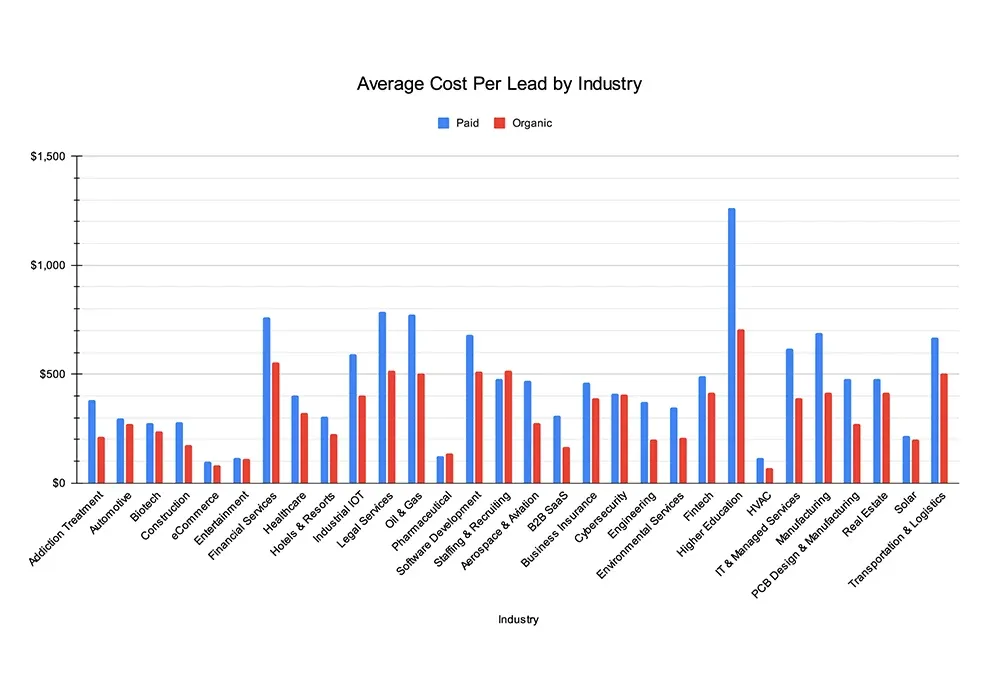
Taken together, these numbers show how widely your ultimate CPL can vary. Use them as a reference, then compare your own costs by channel and industry. You’ll quickly notice which campaigns perform best and which ones just drain your budget.
How to Optimize Lead Generation Costs in 2026
You don’t want to spend $840 on every lead from a trade show. You also don’t want your B2B lead generation costs to go into channels that underperform or a funnel you never measure.
Fortunately, we prepared seven steps you can take to achieve cost effective lead generation:
1. Track cost per lead by channel
Knowing your total lead acquisition cost is great. However, this general number may hide failing campaigns behind successful ones.
Track your CPL separately for email, search ads, social media, and other channels you currently use. Also consider the number of leads each channel gets you and how many of them actually convert. Then allocate more budget to the channels that proved most effective.
2. Cut or pause underperforming channels
This one builds on the previous tip.
Once you track performance by channel, you’ll see which ones fall short and simply waste your money. As a rule, a channel is considered unprofitable if your cost to acquire a customer exceeds your gross profit on that deal.
When you find a channel that underperforms, investigate why. You may need to adjust your targeting or slightly alter your campaign to make it work again. If those changes don’t improve the results, move your budget elsewhere.
3. Increase organic lead share to reduce ad spend
With paid channels, you attract leads pretty quickly. The thing is, you have to pay every time you acquire one. Organic content, on the other hand, attracts prospects without a direct cost for each click or lead.
To capture leads organically, create content around the questions and problems your target audience is searching for. Focus on SEO-optimized middle-of-the-funnel (MOFU) and bottom-of-the-funnel (BOFU) content, such as:
- How-to guides
- Comparison pages
- Alternatives pages
- Case studies
These pieces may take some time to produce initially. However, they’ll keep generating leads long after you publish them.
4. Use AI tools to lower content and outreach costs
We’ve already established that software is cheaper than agency services. And AI lead generation tools multiply that advantage by taking over repetitive tasks. Using them, you can:
- Automate account research
- Verify contact details
- Brainstorm campaign ideas
- Draft or edit copy
- Personalize outreach
- Correct typos and errors in messages
Still, double-check the outputs manually, as AI can get facts wrong from time to time.
5. Reduce funnel steps to lower cost-per-conversion
The more steps in your funnel, the longer the prospects wait and the less patient they get. Review your current journey and look for unnecessary forms, pages, emails, calls, or approval stages.
For example, a SaaS funnel from a paid ad might look like this:
That’s a lot of steps between the initial click and the product offer. Depending on your sales process, you may be able to shorten the journey to a simple ad click, "Try It Now" product demo, and instant account creation.
6. Build a referral process to generate free leads
Referrals are an ideal source of new leads if you already have an active customer base. You just have to make it easy for them to recommend your business to others.
Make sure your referral process includes the following:
- Double-sided incentives: Reward both the referring client and the newcomer with discounts, gift cards, service upgrades, or extended trials.
- Effortless sharing: Make it easy for customers to become referrals with referral links or codes.
- Proper timing: Ask for referrals after a positive customer experience, such as a successful project launch, subscription renewal, and the like.
Referral programs work especially well for local lead generation, where recommendations and word-of-mouth are key in customer acquisition.
7. Set and review 3 to 5 core KPIs monthly
You can only optimize B2B lead generation pricing with consistent progress tracking. So pick three to five KPIs that most impact your operations, for instance:
- Cost per lead (CPL)
- Conversion rate
- Meetings booked
- Customer acquisition cost (CAC)
- Customer lifetime value (CLTV)
Review them every month and compare them with previous periods. Update your processes based on your findings.
Final Thoughts: Balancing Cost and Lead Quality
As you can see, there’s no single answer to “How much does a lead cost?” Benchmarks put the price at around $30 to $300 per lead, and over $2,000 for monthly services. But these numbers don’t necessarily reflect what you’ll pay.
Your industry, target audience, channels, tools, specialists, and lead generation strategy shape the final cost altogether. If your CPL is too high, optimize it. Track every touchpoint and funnel stage, remove what falls short, and use organic traffic and referrals for low cost lead generation.
Cut lead generation costs without cutting lead quality
Try Skrapp for FreeFAQ: Lead Generation Costs
How much does lead generation cost?
Most B2B companies pay between $50 and $500 per lead, depending on the channel, industry, and how strictly they qualify leads. Cold outreach usually sits at the low end ($20-$100), paid ads land around $75-$350, and events can top $500. A qualified lead typically costs two to five times more than a raw one.
How much do lead generation tools cost?
Entry-level contact data and email finder tools like Skrapp usually run $30-$100 per month, and team plans cost $100-$500. Outreach platforms charge roughly $30-$150 per user monthly, while enterprise intent-data platforms can reach $15,000-$100,000 or more per year. Check credit limits and overage fees, since many tools bill per contact rather than per seat.
What are the main lead generation pricing models?
The most common are cost per lead, cost per booked meeting, monthly retainers, tool subscriptions with credits, and pay-for-performance deals tied to closed revenue. Pay-per-lead is easiest to compare across vendors, but cost per meeting or per customer better reflects results.
What is a good cost per lead?
A good cost per lead is one your margins can support. A common rule is to keep CAC below one-third of customer lifetime value, so a customer worth $9,000 should cost under $3,000 to acquire.
How much does lead generation cost by industry?
In B2B, SaaS typically runs $100-$250 per lead, financial services $150-$400, healthcare $100-$300, manufacturing $80-$200, and professional services $50-$150. These figures are directional. Deal size, audience seniority, and sales cycle length affect your real cost more than industry averages do.
Which lead generation channel is the cheapest?
Organic channels like SEO, content, and referrals cost the least per lead over time but take months to build. For faster, low-cost results, targeted outbound with accurate contact data usually offers the best balance of speed and cost. LinkedIn Ads and events are generally the most expensive.
How much should I budget for lead generation?
Many B2B companies put 5-15% of revenue into marketing, with a large share going to lead generation. Early-stage teams often start at $2,000-$10,000 per month. To set your own number, work backward from your revenue goal: how many customers you need, how many opportunities that takes, and how many leads feed those opportunities.
How can I lower cost per lead in outbound prospecting?
Build a small, well-targeted list instead of a large, generic one. A simple workflow is to define your ideal customer, find decision-makers on LinkedIn, and use Skrapp to pull their verified business emails from their profiles. Then add them to your outreach sequence. This cuts manual research time and bounce rates, two of the highest hidden costs in outbound.
How can I lower cost per lead in outbound prospecting?
Build a small, well-targeted list instead of a large, generic one. A simple workflow is to define your ideal customer, find decision-makers on LinkedIn, and use Skrapp to pull their verified business emails from their profiles. Then add them to your outreach sequence. This cuts manual research time and bounce rates, two of the highest hidden costs in outbound.
How do I calculate lead generation ROI?
Subtract your lead generation cost from the revenue those leads produced, divide by the cost, and multiply by 100. For example, $50,000 in revenue from $10,000 in spend is a 400% ROI. Pair it with CAC and payback period for a fuller picture.